
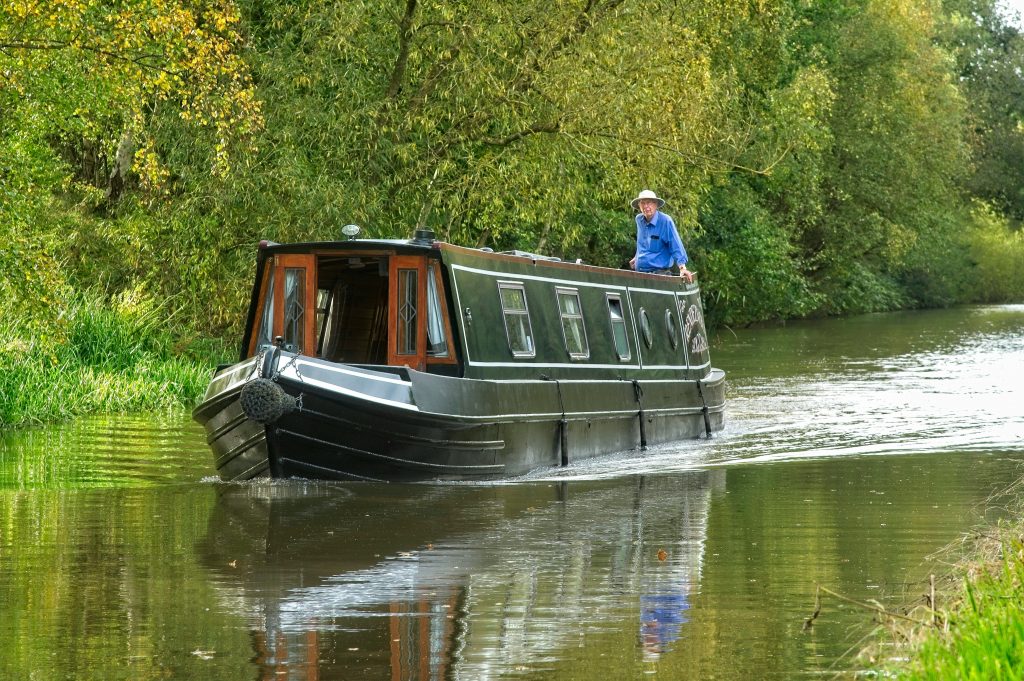
Fishing has long been part of life on the Lancaster Canal. It can give young people a healthy outdoor interest, introduce them to wildlife and provide a peaceful way to spend time by the water. But, enjoying the canal must not come at the expense of the people who live there.
The Lancaster Canal Boaters Association supports responsible angling and wants the canal to remain welcoming to everyone. However, recent incidents at Ashton Basin have raised concerns about fishing immediately beside occupied boats, damage to canal banks, disregard for no-fishing signs and threatening behaviour when boaters have politely asked people to move.
This is not about labelling every young angler as a problem. Most people who fish on the canal behave responsibly. It is about drawing a clear line between legitimate angling and behaviour that damages the waterway, frightens residents or intrudes into their homes.
What has been happening at Ashton Basin?
A recent Beyond Radio report highlighted wider concerns about antisocial behaviour around Ashton Basin following the theft of a boater’s dinghy during the early hours of 3 July.
Alongside that incident, boaters reported teenagers fishing directly beside boat windows, continuing after being asked to move, fishing in places displaying no-fishing signs and digging into the canal bank while searching for bait. The report also described an incident in which an adult angler allegedly threatened a boater who had asked young people not to fish beside his boat.
Detective Inspector Adie Knowles of Lancaster Police subsequently said he would look into the concerns during an on air interview and later during a conversation with the LCBA’s Head of Comms & Liaison, John Hewson.
Listen to the Interview here:
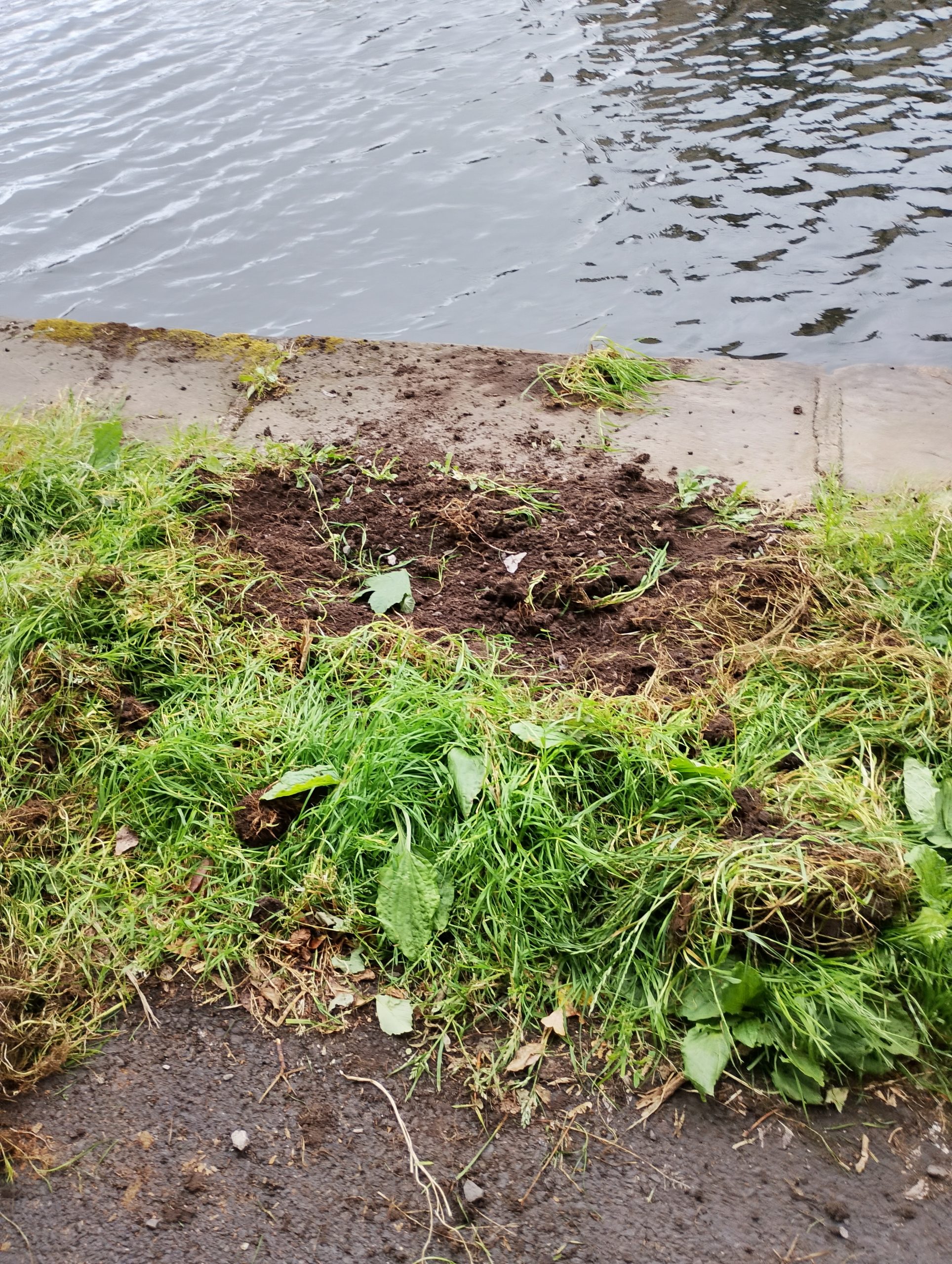
The photographs supplied to the LCBA show disturbed areas beside moored boats, with turf lifted, soil exposed and vegetation left in piles. Similar damage can also be seen beside the basin edge.
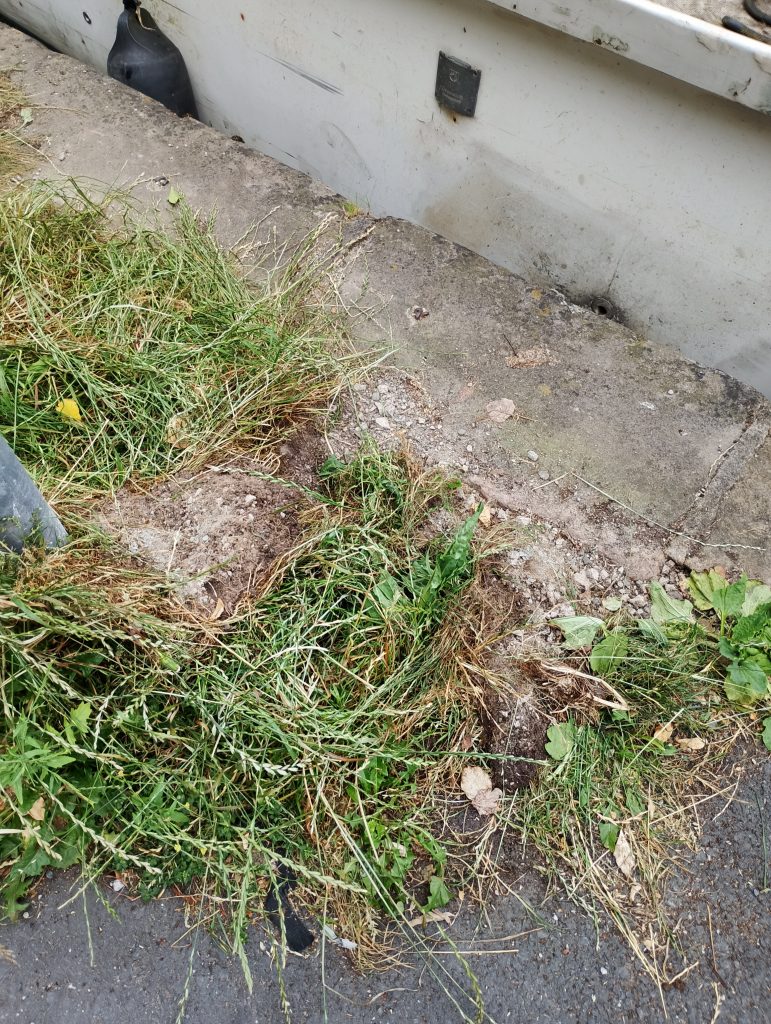
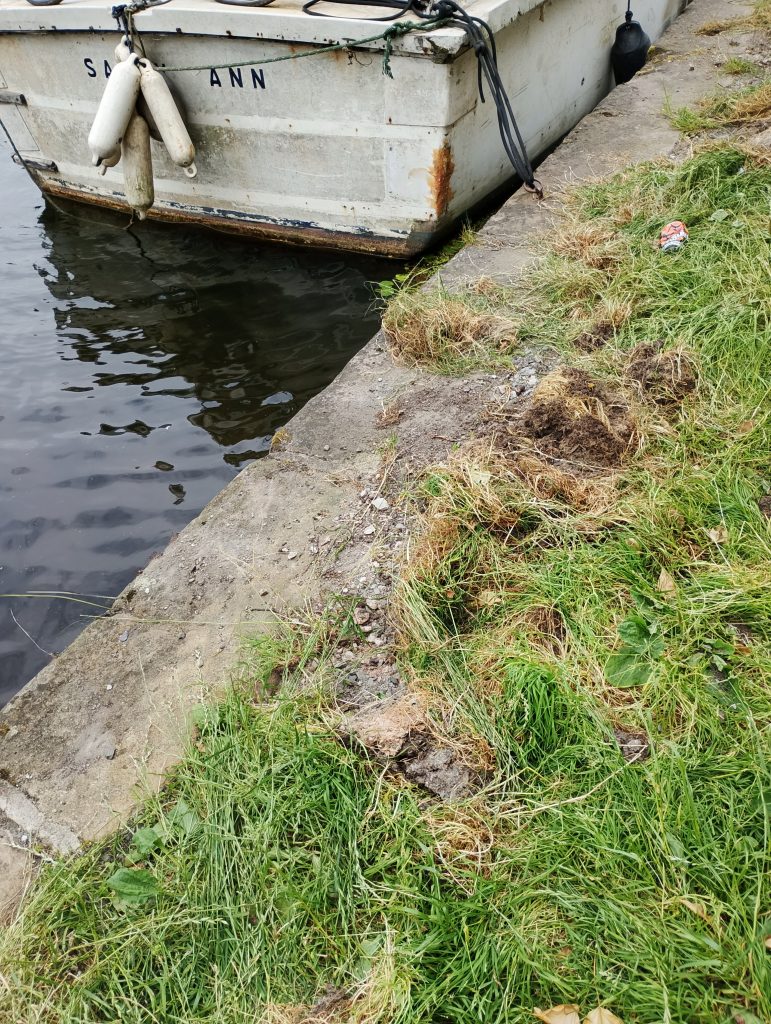
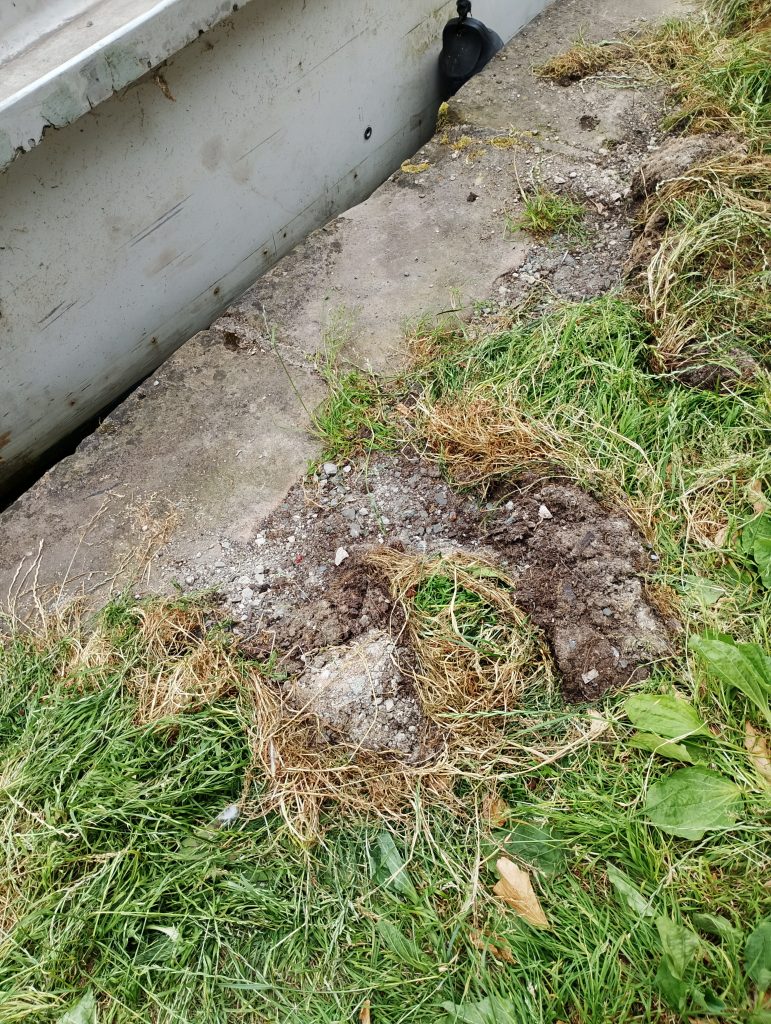
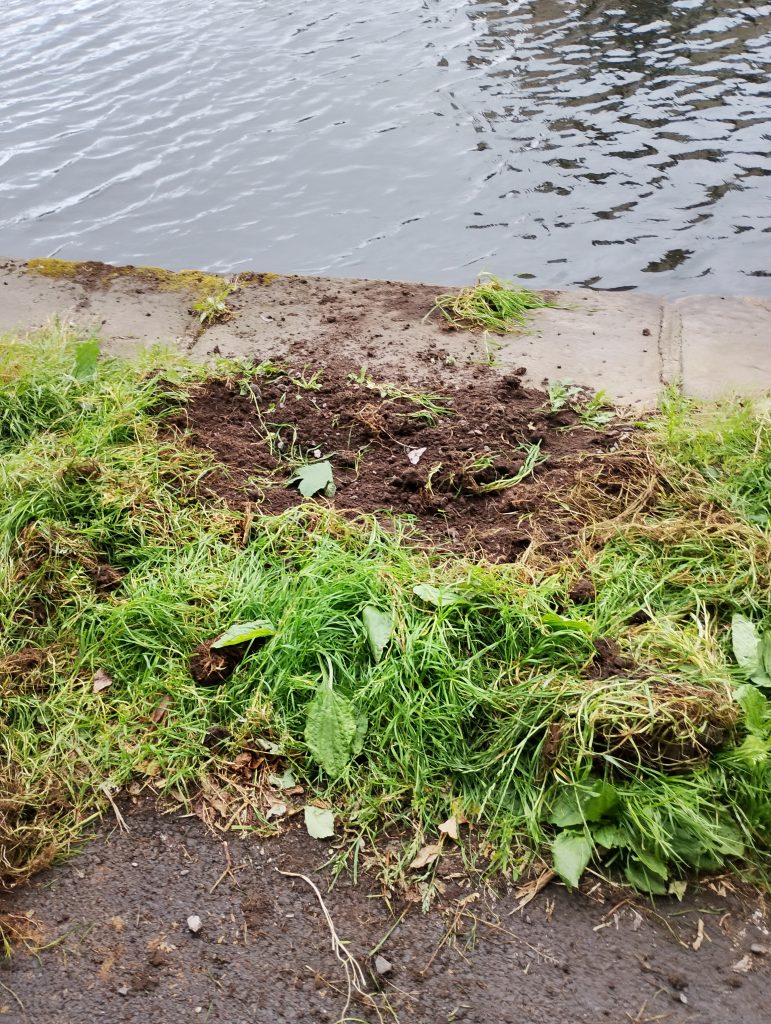
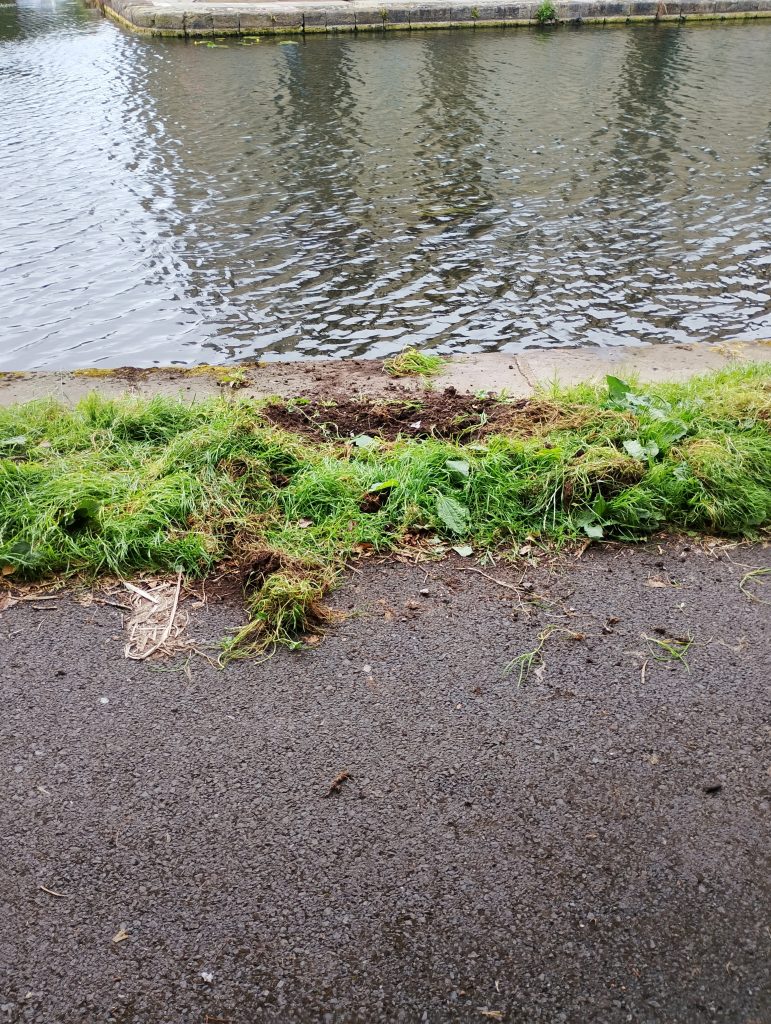
The photographs cannot, by themselves, establish who caused the damage. However, they illustrate the condition about which boaters have complained and why the issue needs to be taken seriously.
Digging into the bank can weaken the canal edge, damage vegetation and create trip hazards. It may also leave the boater moored beside the damage worried that they could later be blamed for it.
The Canal & River Trust’s Waterway Code is clear that canal users should not damage banks or vegetation and should leave the area as they found it.
A boat is somebody’s home
One of the difficulties at Ashton Basin is that visitors may see boats as part of the scenery rather than occupied homes.
Fishing directly against a boat window can feel very different to fishing near an unoccupied vehicle or structure. The person inside may be sleeping, dressing, working or simply trying to enjoy some privacy.
Boaters understand that the towpath and canal must be shared. In return, people using the bank should recognise that looking through windows, climbing onto boats, leaning equipment against them, casting across them or refusing a reasonable request to create some space can be intimidating and intrusive.
An activity may be lawful in principle while still being carried out inconsiderately.
What are the rules about fishing near boats?
There is not a blanket rule banning fishing anywhere near a moored boat. The position is more nuanced.
The Canal & River Trust says anglers may fish opposite moored boats, but they should take particular care not to get hooks, tackle, bait or groundbait onto the boat. Excessive noise should also be avoided.
Fishing may also take place near boats moored on the towpath side where there is suitable space. However, that does not give anyone permission to interfere with a boat, obstruct access to it or behave in a way that causes harassment, alarm or distress.
At permanent moorings, fishing between boats is not permitted. At visitor moorings, fishing is prohibited where signs say so. Where there is no sign, fishing may be allowed if space is available, but boats wishing to use the mooring have priority and anglers may be asked to move.
Fishing is also prohibited:
- In a lock chamber or within 25 metres of a lock approach.
- Within 25 metres of a water point.
- Within 25 metres of a moveable bridge used for navigation.
- Near overhead power lines.
- In any location where signs specifically prohibit it.
The rule concerning moveable bridges should not be confused with a blanket prohibition on fishing near every ordinary canal bridge. Nevertheless, fishing from the top of a bridge, casting where people or boats pass below or entering a signed restricted area can be dangerous and should be reported.
Licences and fishing permission
A rod licence and permission to fish are two different things.
Anyone aged 13 or over fishing for freshwater fish in England must have an Environment Agency rod licence. Junior licences for people aged 13 to 16 are free, but they must still be obtained. Children under 13 do not require a rod licence.
A rod licence does not automatically give someone permission to fish wherever they choose. Anglers also need permission from the owner of the fishing rights, normally through an angling-club permit or an appropriate Canal & River Trust permit.
No-fishing signs and local restrictions must still be obeyed, regardless of whether someone holds a rod licence.
How boaters should respond
Boaters should not put themselves at risk by entering into a confrontation, particularly where a group is involved.
Where it feels safe, a calm explanation may resolve the problem. Young anglers may simply not understand that the boat is occupied or that they are fishing beside somebody’s bedroom window.
Where someone refuses to move, becomes abusive, damages the bank or threatens a resident, the incident should be recorded and reported. Useful information includes:
- The date, time and precise location.
- A factual description of what happened.
- Descriptions of those involved.
- Photographs of damage taken from a safe position.
- Details of witnesses.
- Any police, council or Canal & River Trust reference number.
People should avoid publishing identifiable photographs of children on social media. Evidence should instead be retained for the appropriate authorities.
Who should incidents be reported to?
Call 999 where a crime is taking place, somebody is in immediate danger or violence is being threatened.
For non-emergency crime, intimidation or antisocial behaviour, contact Lancashire Police through its online reporting service or by calling 101. Reporting each incident matters because it helps police identify recurring locations, patterns and times.
Damage to Canal & River Trust land, persistent problems at a mooring or waterway incidents can also be reported to the Trust through its incident-reporting form or by calling 0303 040 4040 during normal office hours.
Suspected illegal fishing, including possible rod-licence or fisheries offences, can be reported to the Environment Agency’s 24-hour incident hotline on 0800 80 70 60.
LCBA members are also encouraged to inform the association, preferably with the official incident reference number. This allows the LCBA to identify repeated problems and raise them constructively during its discussions with Lancashire Police, the Canal & River Trust and Lancaster City Council.
Sharing the canal fairly
Ashton Basin should be a place where young people can enjoy the outdoors, anglers can fish responsibly, visitors can walk beside the water and boaters can feel secure in their homes.
Those aims are not incompatible.
The answer is not to drive young people away from the canal. Better information, properly enforced restrictions, suitable fishing locations and engagement with local schools, youth organisations and angling groups could help turn a source of conflict into something positive.
But sharing the canal requires mutual respect. Responsible fishing does not involve digging up the bank, ignoring signs, casting beside someone’s window, damaging property or threatening a resident who asks for some space.
The canal belongs to a broad community. For some it is a place to visit. For others, it is home.